
Pre-Mystrigue (2024-2025)
Introduction
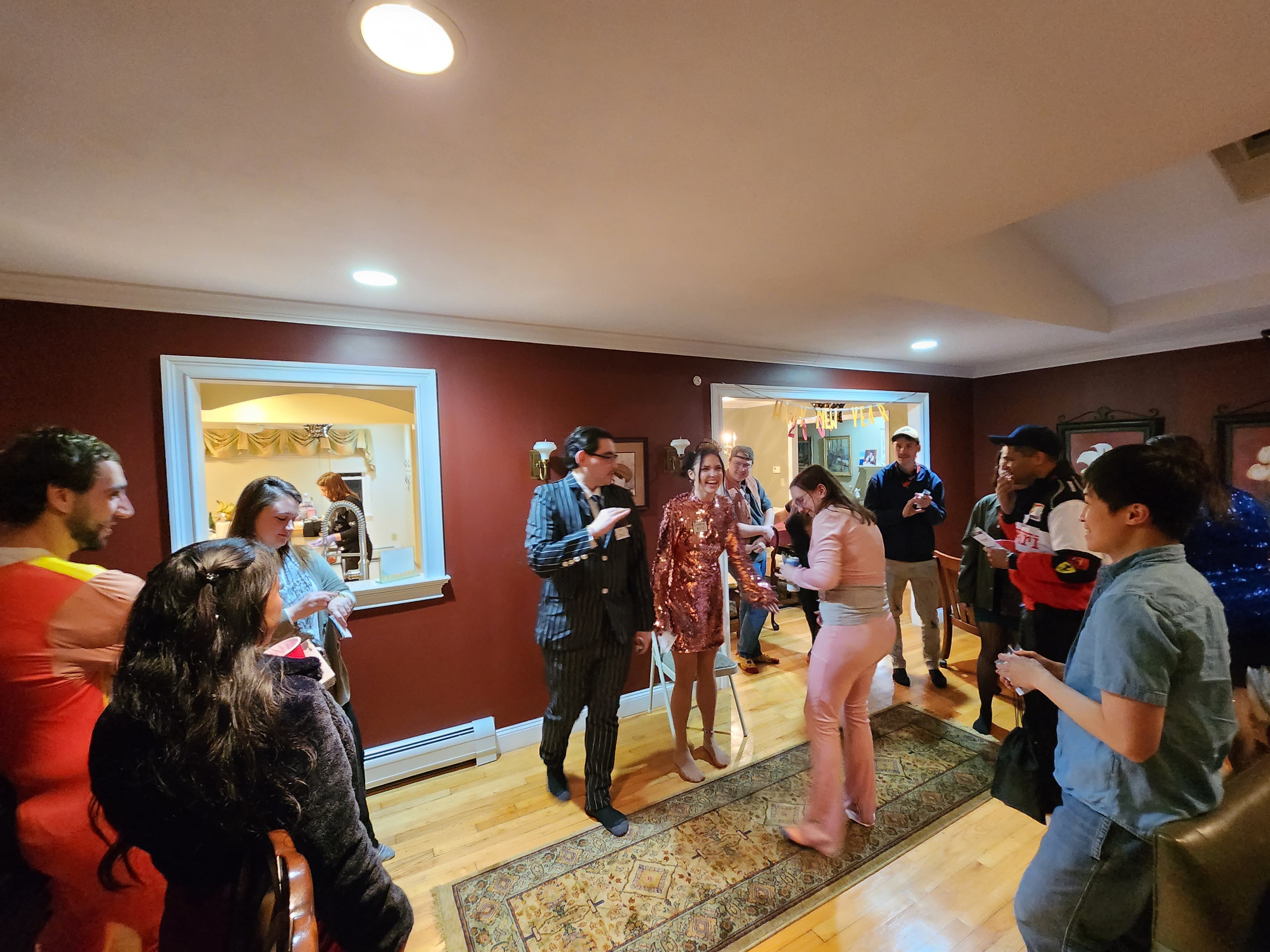
Over the last 10 years it has been a common occurrence that Tom or I host New Years Eve gatherings for all of our friends. Normally, this only involves planning the menu and creating a list of quick and easy party games we want to play. Towards the end of 2024 we had been talking with our friends about what would be a fun and different game for us to all play for the next New Years party. It was in November when one of our high school friends suggested we look at playing a pre-packaged murder mystery kit.
Setting up and playing the murder mystery game
To play the game, we needed to assign characters to each of our friends and create and distribute a set of paper printouts for the game. This game works across 3 rounds where in each round, a self-crafted printed out booklet is given to each player. The booklet provides the player with their instructions for the round, including who to talk to, what to say, and how to generally act as their character.
It was interesting using time gated “clues” as a way to give new information to characters and create interesting interactions. One of the most memorable moments for me was seeing a player dramatically propose to one of her in-real-life best friends, only to get rejected and start fighting with each other.
Limitations of the kit and ideas for advancing the genre
Importance of all characters
Overall, it was a great experience, but there were a few design mechanics which I felt limited the potential of the game. Of the 20 maximum players the murder mystery kit supports, only 5 are actually needed to play the game. The consequence of this was that all of the other characters felt like side characters. Only those 5 initial characters actually mattered to the story. The way the round clues are written is that additional characters are added in as groups and they only have direct talking tasks to the main 5, their own group, and any group designated to be assigned before theirs.
As the moderators of the game, we already knew about the “main” characters, however the players at the party quickly realized this as well. While I understood the design choice that every character can’t be the main character of a story, the balance still didn't feel right to me. Another reason I speculate it is designed this way is that when organizers of events are handing out characters to players it's impossible to have an exact character roster as intended for a large party game. The creators of this murder mystery kit used this game design as a solution to this successfully, however I believe it creates strong imbalances in the characters they design for their players.
Character backstory and player understanding of their character
Another aspect of character balance I felt was lacking was players not knowing their own character's history that is important to the story being told. Here are a couple examples from my own character I played:
At one point during the first round another player came up to me and said, “Hey, we used to date. Tell me what's going on at the party or else I will tell everyone about us.” At no point was I given information to confirm my own history if this was true or not. I had to roll with it, which is okay, but it feels weird as a player to not know your own character's history. This example is partly due to the other character being a “side character” as explained above.
Another egregious example of this for my character was that I had no idea I was the murderer! It feels very strange to me that I am acting out a character who intends to murder someone but I myself don’t even know my own intentions. I feel as though I should have to struggle and act that my character is normal throughout the night and not learn of this towards the end of the game. As I am writing this over a year after this event having played our newly developed game twice I can say one feedback from players is that they always want more background information about the characters they are playing. So I sympathise with the developers here a bit when it comes to having an insatiable player base however I still firmly believe any character history paramount to the story should be told to that player and they should not be hearing it through another character.
What does it mean to win a murder mystery?
Last and most important to me I felt missing in this game was discrete win conditions for all of the players. The way the murder mystery ends is everyone discussing who we think the murderer was and then one final vote. As a murder mystery I think this a reasonable way to end the game but I wasn't quite satisfied. Without a doubt all of the players had a fun time but it felt more as if we were going through the motions of acting out a script and less of a game where one feels like they could accomplish an objective to win. Especially with the focus of the ending vote for the murderer being so centered on the 5 main characters. This again plays into player agency and making a game with mechanics and a story where all characters are treated equally. The question was how would this be done?
Acknowledgement
I’m really thankful to the creators of the murder mystery scenario we played for introducing me to the genre. Their way of pocketing information into rounds to advance the story they wanted to tell was very inspirational and set me on the road of game design.
What’s Next
In the future I hope to find creative solutions to the limitations I have discussed above. This includes creating characters that all feel like they matter to the players, how to deal with cancellations or too few players for a scenario, and how to set up meaningful win conditions for a large group of players.